• Home
  • Blog EN
  • Blog DE
  • 4M
  • Homegrown
  • About
  • Home
  • Blog EN
  • Blog DE
  • 4M
  • Homegrown
  • About
The Future of Work & Education

FILM REVIEW: POPE francis - A man of his words by wim wenders

9/27/2018

Comments

 
Picture
Wim Wenders was recently called by a friend of mine a “hero of beauty.” Since the 2014 documentary The Salt of the Earth, the biography of Brazilian-French economist and photographer Sebastiao Salgado, I agree with this title. But also earlier works like Buena Vista Social Club or Wings of Desire have earned him a place in the Olympus of filmmakers. Contrary to the second great German born director Werner Herzog, Wenders does not focus on the cinematic elaboration of complex social issues, but on unorthodox heros; and while Herzog’s work is an expression of his second passion, i.e. writing, Wenders has essentially remained to the great pleasure of his visual audience a photographer. He doesn’t tell a story, but asks others to tell one and captures this story in breathtaking or at least memorable images.
 
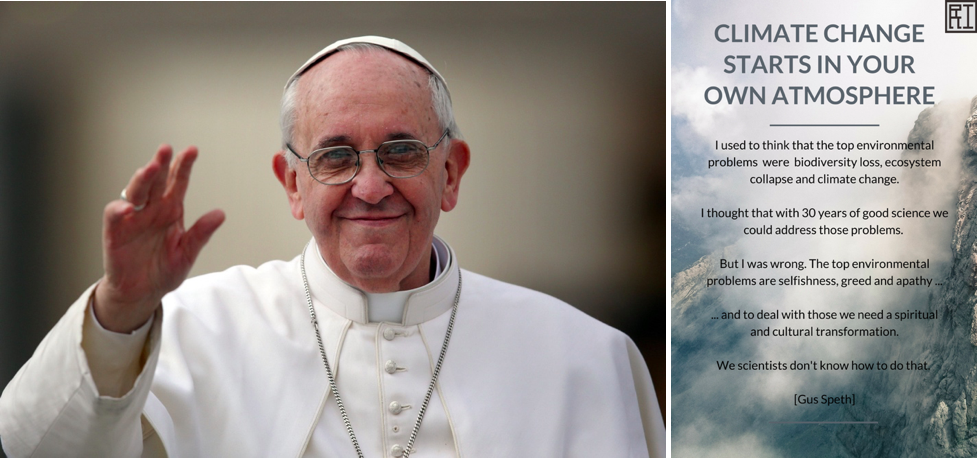
So, why did he agree in 2015, when asked by the Holy Vatican to shoot a film about Pope Francis? Aren’t there more beautiful, in particular visually beautiful stories to be told? The answer comes as a revelation when I leave the cinema several times moved to tears by an old and mighty man who reigns over one of the if not the largest international organization, the Holy Roman Catholic Church, which is able to finance the stable employment of about half a million people, i.e. the global clergy consisting of but not limited to more than 5000 bishops and more than 400k priests. Pope Francis is a gentle, humble and modest man who never aspired to lead the hierarchy of the Catholic Church. His story is not one of visual beauty, but one about beauty from within, one that rests on values which this world is in dear need of.
 
Now, some might call me (like Wim Wenders) a Pope Francis fanboy. I don’t mind. There are too many people out there who cannot differentiate between the organization, i.e. the institution Church, and the single people which act in and through it. Like money or power, organizations, which have plenty of both, can be used for creation or destruction. Pope Francis might have a good PR director, but we all surely acknowledge that the flood of information which hits our brains in increasing intensity since the 1980s makes this necessary (compare what I have written earlier about cognitive psychologist Daniel Levitin and educator Neil Postman).
 
Papa Francesco is explicit about pedophilia. He condemns it. For some this is not enough. But we should remind ourselves that getting the top spot in any organization does not give the power to change it entirely. Many wished that Barak Obama could transform the US into a more social nation and were shocked with how many political measures including wars he had to and did go along. But for some Obama will be remembered as introducing general health care and they understand that a single human being cannot take care of all evils in this world in a limited lifetime or even less so in the few years of a presidential term. They will see that the focus on one top priority makes sense if one acts in general with values and principles that are in line with the well-being of all; and if this priority’s targets are met, they will call it a success.
 
Pope Francis might be remembered for his 184 page encyclical letter Laudato Si, in which he defines the protection of this planet, our common home, as his top priority. Let’s hope that he meets his targets, because his letter interestingly coincides with the increasing number of scientists appearing in public like e.g. Alice Bows-Larkin, who warn about a sixth mass extinction caused by human-made climate change. One could argue that the Pope does tune into a widely played melody (a rather cacophonic one to be sure), but he does so with interdisciplinary wisdom which I have rarely if ever seen before. He connects the environmental disaster with our social disaster and sums it all up in his three T: trabajo, tierra and techo.
 
What a world is this, he asks, where large swaths of humanity are without work (trabajo) and without land (tierra)? It is a world with a rotten roof (techo), one which is about to collapse. And he puts forward a simple Jesuit solution to this problem: let us all have a bit less and share more. A solution which makes so much sense since we witness a rise of mental health issues in rich industrialized nations (burnout, loneliness, isolation, neurosis, ADHD, etc.) while poverty struck regions on this globe still have to fight for material survival. He even goes so far as to explain drug abuse as a desire to escape from a dominant culture, from an economy which kills (una economia que mata) the planet and the people. He is explicit although he knows that many don’t want to hear this truth, in particular in countries like the US where truth has been kicked to the ground and rolled in dust and dirt. 
 
Further info:
https://en.wikipedia.org/wiki/Pope_Francis:_A_Man_of_His_Word
https://www.rogerebert.com/reviews/pope-francis-a-man-of-his-word-2018
http://w2.vatican.va/content/dam/francesco/pdf/encyclicals/documents/papa-francesco_20150524_enciclica-laudato-si_en.pdf
Comments

The Practice of the WIld. REviewing Gary Snyder's Guide to Sanity.

9/27/2018

Comments

 
Picture
Critique of Gary Snyder’s writing feels like a sacrilege against the beauty of letters, nature and the elders. Not knowing if he deems me worthy of such relationship, he makes himself a point to assume the position of the grandfather I never had: My own grandparents certainly didn’t tell us stories around the campfire before we went to sleep. Their house had an oil furnace instead, and a small library. So the people of civilization read books. For some centuries the “library” and the “university” have been our repository of lore. In this huge old occidental culture our teaching elders are books. Books are our grandparents!
 
This book should get praise only. Like Wes Jackson, a geneticist friend of Synder writes: I have always found it difficult to imagine this century without the life and work of Gary Snyder. After reading this collection of essays, I now find it impossible. I could not agree more and would say that The Practice of the Wild is even more a mandatory read in the 21st century than it was in the 20th. Although an entire generation has been influenced by Snyder, I am surprised that he is not more widely known or at least added to the recent discussion around a Western education canon.
 
This collection of nine substantial essays is summarized by Snyder in his own words: Our immediate business, and our quarrel, is with ourselves. It would be presumptuous to think that Gaia much needs our prayers or healing vibes. Human beings themselves are at risk – not just on some survival-of-civilization level but more basically on the level of heart and soul. We are in danger of losing our souls. We are ignorant of our own nature and confused about what it means to be a human being. Much of this book has been the reimagining of what we have been and done, and the robust wisdom of our earlier ways. Like Ursula Le Guin’s Always Coming Home – a genuine teaching text – this book has been a meditation on what it means to be human.
 
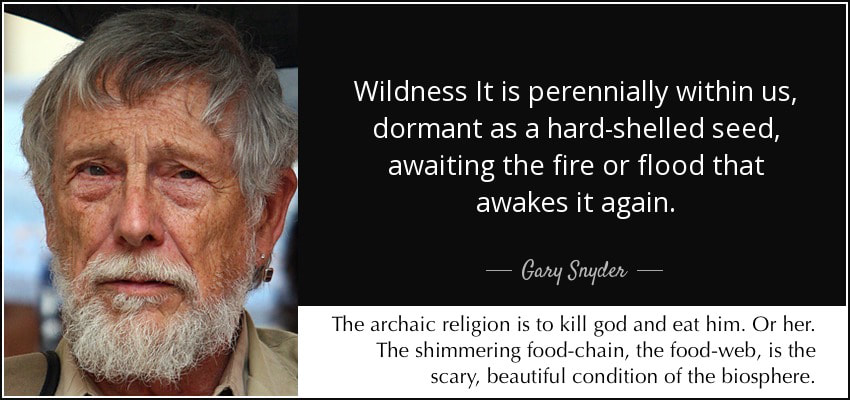
But reading them I am left with a decisive uneasiness. If such a widely travelled and learned man like Synder writes in all this erudition quite gloomily about our relationship with ourselves, others and the planet, is there any hope left? Snyder does not give an explanation why all these local cultures and many species are under threat or already extinct. He wails in beautiful prose and some poetry over the lost diversity and richness of wilderness. But he does not explain why cultures undergo these breakneck transformations. Quite on the contrary, Snyder argues that the only meaningful explanation for all the environmental devastation, murdering of fellow human beings and extermination of other species is “spiritual Darwinism.”
 
He refers to Pierre Teilhard de Chardin, a French Jesuit who claims a special evolutionary destiny under the name of higher consciousness and misinterprets his 20th century writing as a form of transhumanism: man is on a path to leave the rest of earth-bound animal and plant life behind to enter an off-the-planet realm transcending biology. He calls Chardin an anthropocentrist new age thinker and counters his teachings with the radical critique of the Deep Ecology movement.
 
It is probably not a coincidence that I read almost parallel to Gary Snyder, recommended by a dear American friend, Sadhguru’s Inner Engineering, recommended by a dear French friend. Both writers are sages. Snyder is a cosmopolite anthropologist who excels in describing how nature, sacredness and wildness interact and what it is that we have lost. Sadhguru is a yogi who has reached a special state of consciousness and shares many insights which proof his human engineering competence. But there is a qualitative difference between these two books: Snyder is modest and humble while Sadhguru appears to be patronizing and proselytizing.
 
It is though Sadhguru how reconciles Snyder and Teilhard de Chardin when he explains that there are two basic forces within you. Most people see them as being in conflict. One is the instinct of self-preservation, which compels you to build walls around yourself to protect yourself. The other is the constant desire to expand, to become boundless. These two longings – are not opposing forces, though they may seem to be. They are related to two different aspects of your life. One force helps you root yourself well on this planet; the other takes you beyond. Self-preservation needs to be limited to the physical body. If you have the necessary awareness to separate the two, there is no conflict. But if you are identified with the physical, tehn instead of working in collaboration, these two fundamental forces become a source of tension. All of the “material-versus-spiritual” struggle of humanity spring from this ignorance. When you say “spirituality,” you are talking about a dimension beyond the physical. The human desire to transcend the limitations of the physical is a completely natural one. To journey from the boundary-based individual body to the boundless source of creation – this is the very basis of the spiritual process.
 
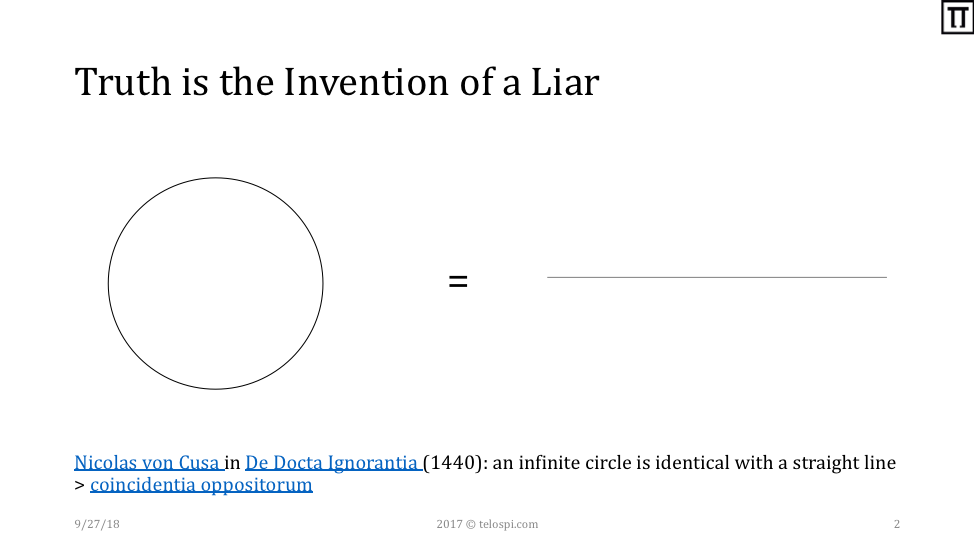
In as such, Snyder and Teilhard de Chardin describe the same thing but from two different perspectives. One describes the journey from the physical towards the spiritual and emphasizes that there is no spirituality, no soul, without respect for the own, the other and the body of mother Earth. The other describes the omega point as a final destination of consciousness evolution and explains the turmoil in the physical world thereby. Both man are deeply rooted in the phenomenal world, one as keen observer of human culture and custom, the other as geologist and paleontologist. Both men go beyond the phenomenal world and try to understand the noumenal world; one through the multitude of native rituals, the other through the singularity of Christianity. Both got a point, but I can’t help to be reminded of Heinz von Förster’s anectode in Understanding Systems about the 15th century mathematician Nicolas of Cusa who proofed that an infinite circle is identical with a line.
Picture
Both seem to recognize that it is culture which requires a transformation. One shows us what our ancestors have done right, the other explains what we still need to learn in order to progress and evolve. Snyder writes that greed exposes the foolish person or the foolish chicken alike to the ever-watchful hawk of the food-web and to early impermanence. Preliterate hunting and gathering cultures were highly trained and lived well by virtue of keen observation and good manners; as noted earlier, stinginess was the worst of vices. Teilhard de Chardin emphasizes the force of love to drive giving instead of taking.
 
Snyder teachers us that the term culture goes back to Latin meanings, via colere, such as “worship, attend to, cultivate, respect, till, take care of.” The root kwel basically means to revolve around a center – cognate with wheel and Greek telos, “completion of a cycle,” hence teleology. In Sanskrit this is chakra, “wheel,” or “great wheel of the universe.” The modern Hindi word is charkha, “spinning wheel” – with which Gandhi meditated the freedom of India while in prison. He shows that a culture is like a giant trap, a huge flywheel. Once put in place or motion it is difficult for the individual to escape.
 
Teilhard de Chardin interprets increasing complexity as the axis of evolution (a concept which is the central pillar of modern big history) of matter into a geosphere, a biosphere, and finally into consciousness and then to supreme consciousness (the Omega Point). He explains – and that’s probably the part in his writing which Snyder dislikes – that evolution shifted from the realm of physics into chemistry from chemistry into biology, and from biology into culture. And it is in this last realm that man dominates over all other elements in this universe.
 
Synder does though agree with Chardin between the lines, because this passage shows that he has already in the late 1980s if not earlier anticipated the dawn of the Anthropocene: A culture of wilderness starts somewhere in this terrain. Civilization is part of nature – our egos play in the fields of the unconscious – history takes place in the Holocene – human culture is rooted in the primitive and the Paleolithic – our body is a vertebrate mammal being – and our souls are out in the wilderness.
 
I warmly recommend to read this book and watch in the course of doing so films like The Revenant (about nature, wildness and the sacred) and Wild (about the healing force of the wild), Into the Wild (about the deadly force of the wild and the necessity for man to be part of some sort of civilization), 127 Hours (about the attraction of the wild), Captain Fantastic (about wildness and parenting) or The Deer Hunter (about the conflation of sacred wildness and social sickness).
Comments

FILM review: The Challenges of RUdolf Steiner

9/5/2018

Comments

 
Picture
Filmed in 2011, this two-part documentary by veteran film-maker Jonathan Stedall tells the story of philosopher Rudolf Steiner’s remarkable life (1861-1925) and explores the influence of his ideas and insights on a whole range of contemporary activities – education, agriculture, medicine, social and financial issues, and the arts.
 
Stedall starts with a rather ontological question “Where do we come from, what are we, where are we going?” and acknowledges that the visionary Rudolf Steiner, who planted in a generally backward environment seeds for the future, has given him so far the most profound answers. Stedall follows Steiner’s biography in part one and starts at the margins of the Austrian-Hungarian empire in what is now Croatia in order to elaborate on the main stations in his transformative life: Pötschach in Lower Austria, Vienna, Weimar, Berlin and finally Dornach in Switzerland.
 
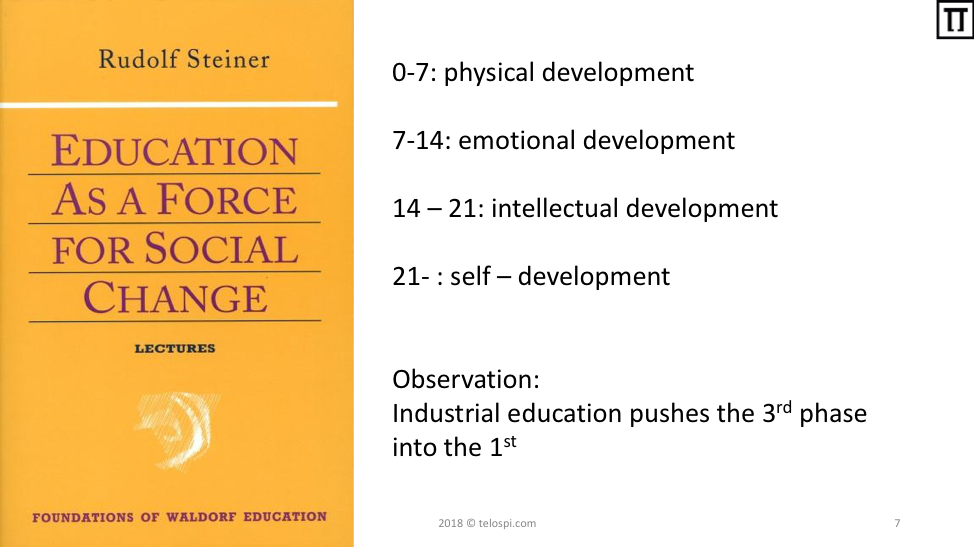
The biographical account which is also an interesting document of cultural evolution during before and after WWI in Central Europe is blended with several interviews of people who have studied and practice Steiner’s teachings. We are introduced to the basic concepts of his educational theory like “unlearning what we have learned so far” or that physical dexterity in early childhood translates to dexterity of mind and thought in late childhood and adolescence.
 
We learn that Steiner invented eurhythmy, a dance like performance art, because he realized early on that harmonious movement is in modern societies rather the exception than the rule. Eurhythmy, which can also be applied as a form of psychotherapy heals through movement by overcoming the heaviness of the earth through rhythm. An interviewed teacher explains how these natural rhythms are tied to our emotions: Laughing is breathing out, crying is  about breathing in. I recall a nature documentation which I watched last year about the pairing dance of birds, in which the speaker said: with each synchronized movement grows mutual trust confirming that there is much more about communication than words in the entire animal kingdom including us.
 
Biodynamic agriculture, a forebode of permaculture and much of what is now summarized under the umbrella term organic agriculture, was Steiner’s late brainchild. He reinstated ancient farming calendars, which observed and understood the basic principles of nature at a time when modern farming techniques are only about to take hold of the industry. Steiner understood agriculture as a process to heal the earth. He was by any means far ahead of his time and would have probably burnt at the stake during the medieval inquisition for proposing to farmers to apply strangely prepared fertilizing mixtures called 500 and 501. He conceived them as medicine for the earth.
 
We are introduced to the Camphill Movement, which was founded in England during WWII by one of Steiner’s disciples, the physician Karl König. It is based on the anthroposophical principle that all life has value and therefore establishes in contrast to the holocaust an inclusive approach to education and work. Mentally and physically handicapped are embraced and made an integral part of society. We start to suspect that it is actually us normal folks, who receive healing through vulnerability and innocence.
 
Felix Koguzki, a Viennese herbalist who transferred an overview of the traditional central European plant knowledge to his friend Steiner, is shown at the brink of WWI as a dying species: hunter & gatherer generalists who had a wide knowledge of the local ecosystem. Its amazing to realize that this knowledge started to disappear already more than a century ago and that slow science – taking five minutes to look at a plant – is something that needs to be kindled in every child in order to instill and maintain awe for the natural world. How difficult has this become in our times when the natural world competes with the dopamine addiction generates by the cyber physical space.
 
We are left in part one with the impression that Steiner was a natural scientist like his 18th century forefathers Alexander von Humboldt and Wolfgang von Goethe who was moreover blessed and cursed with a mystical perception of the spiritual world. He tried to merge science and spiritualism and recognized early on that the increasingly dualist worldview of modernist societies conditions us to disregard the wonders of the phenomenal world and the miracles which hide beyond it.
Picture
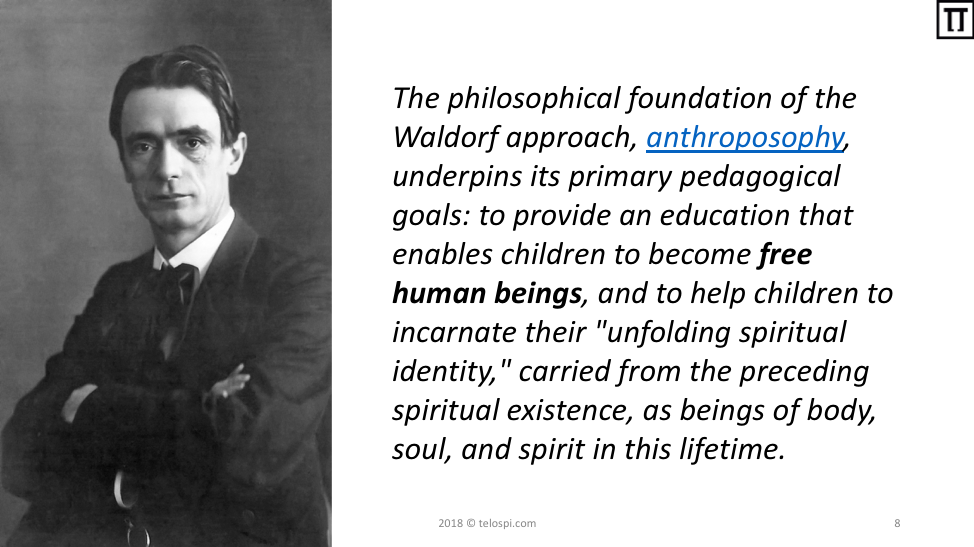
Part two zooms in on Waldorf education and biodynamic agriculture. We are being told that children need to be given time to develop properly and that education is not about imparting knowledge but about awakening and nurturing what children already know. We learn that Steiner’s meta-philosophy was one of consciousness evolution and that karma and reincarnation can make us remember the true purpose of why we are here.
 
The president of the US anthroposophical society summarizes the challenges of contemporary education systems when he says that the great crime of our time is that the intellectual adult consciousness is pressed on the child in the name of performance and academic achievement. It is a crime because we deny the innate qualities of childhood at that time. We should be alarmed, because at what he describes of the American education system is meanwhile true all around the globe: The pressure on children through testing which started during the Bush era and continued throughout the Obama era gives no space to Waldorf education and thus no space to unfold their spiritual identity.
 
I recall a scene with my eldest niece who graduated two years ago from high school in small Austrian city not far from Vienna and not at all far from where Steiner spent his youth. During the months of preparation for the high school graduation, so she told me, one of their teachers tried a disturbing method of getting her pupils motivated. Most likely influenced by the results of recent PISA tests, which put 14/15 year olds into a globalized and industrialized format of skill and competence assessment, she explained them that if they would not work hard their jobs will be taken by Chinese of the same age.
Picture
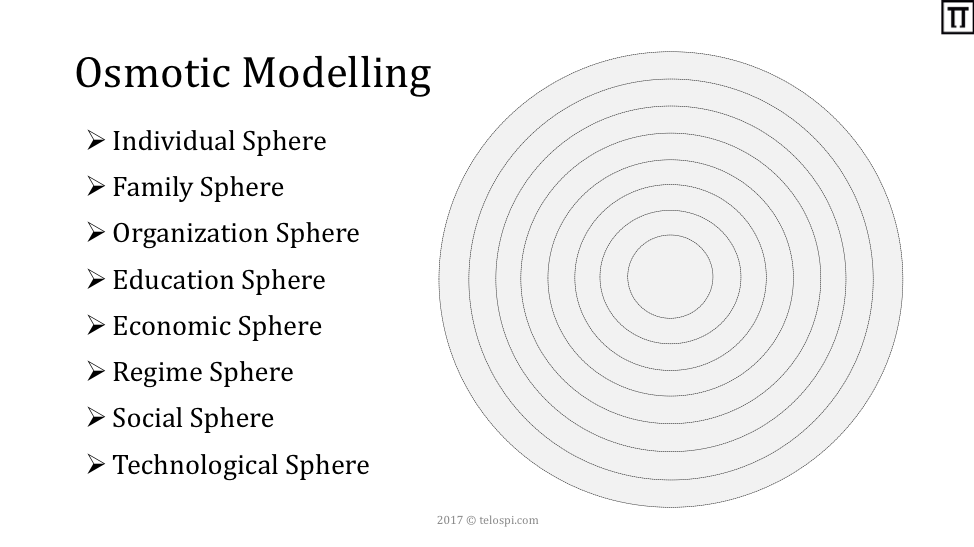
Our education systems – no matter in which country – are to a large extent the result of competing knowledge economies. A systems theory perspective reveals that this competition is translated from the regime sphere which is dominated by the modern science-technology-power complex to ministries of education, from there to municipal education bureaus, from there to school principals, from there to teachers and from them directly into our children.
 
Instead of granting our children a learning environment which enables them to unfold their innate nature, we put them into system which force feed them and turn them into automatons, who in turn become unhappy adults, obedient nation state citizens and loyal consumers. Waldorf education helps children to think out of the box. Its thus no surprise that Steiner’s philosophy is in conflict with existing power structures. Waldorf education deals with what the children are by instilling a sense of trust into one’s own intuition through love and a sense of trust into society at large through collaboration. Traditional education systems deal with external demands of society and instill into our children competition and fear.
 
A German physician practicing anthroposophical medicine in Sweden concludes that Steiner’s main contribution to medicine at large was the biographical perspective. He saw disease and illness as a result of unique biographical conditions and the medical practitioner’s task in understanding this dynamic between cause and effect. One could say that Steiner was a natural etiologist who encouraged physicians to go beyond modern tools of diagnosis and standardized methods of treatment and cure.
 
A British general practitioner furthermore vindicates Steiner from quackery. His approach of bridging science and spirituality made him embrace modern medicine as powerful toolkit to work with, but he pushed with anthroposophical medicine physicians to go beyond the mechanistic perception of the human being and arrive at a holistic understanding of human nature as both material and spiritual entity.
 
Rudolf Steiner’s fundamental legacy is that he saw the world as it could be and not as it was. His challenges were certainly to be not understood by his contemporaries, so his path was then a lonely one. We must also recognize that he early on fixed a broken education system, which has increasingly severed academic knowledge creation from practical wisdom. In Return to Meaning: A Social Science With Something to Say three contemporary authors point at this epidemic of meaninglessness and resource waste. They criticize the proliferation of meaningless research, of no value to society, and modest value to its authors - apart from securing employment and promotion.
 
A look at mental health data clearly shows that we have arrived at a crossroad which makes it necessary that we listen to Steiner’s messages and act upon his practical recommendations. For the sake of ourselves and for the sake of those whom we love most: our children.
 
Official film synopsis:
http://rudolfsteinerfilm.squarespace.com/synopsis/
 
Comments

    Archives

    January 2026
    December 2025
    July 2025
    May 2025
    October 2024
    March 2024
    May 2023
    March 2023
    January 2023
    October 2022
    May 2022
    February 2022
    January 2022
    December 2021
    November 2021
    May 2021
    April 2021
    March 2021
    February 2021
    January 2021
    December 2020
    November 2020
    October 2020
    September 2020
    August 2020
    January 2020
    October 2019
    February 2019
    December 2018
    November 2018
    October 2018
    September 2018
    August 2018
    July 2018
    June 2018
    May 2018
    April 2018
    March 2018
    February 2018
    January 2018
    December 2017
    November 2017
    October 2017
    September 2017
    May 2017
    April 2017
    March 2017
    February 2017
    January 2017
    December 2016
    November 2016
    October 2016
    September 2016
    August 2016
    July 2016
    June 2016
    May 2016
    April 2016
    February 2016

    Categories

    All
    AI
    Alienation
    Anthropocence
    Artisanship
    Automation
    Basic Income
    Brotherhood
    Capitalism
    Circular Economy
    Cities
    Compassion
    Compulsive Hoarding
    Consumerism
    Countryside
    CSR
    Education
    German Elections
    Gratitude
    Human Development
    Identity
    Information
    Language
    Learning
    Materialism
    Meditation
    Metamorphosis
    Migration
    Mindful Consumption
    Parenting
    Purpose
    Purpose And Midlife Crisis
    School
    Transformation
    Travel Industry
    Wildness
    Work
    World Order

Powered by Create your own unique website with customizable templates.